Lets Make This Nation Great Again Philippines
ASEAN Beat |Politics |Southeast Asia
Son of Philippine Dictator Marcos Announces Presidential Entrada
Ferdinand "Bongbong" Marcos Jr. has promised the Philippine people "unifying leadership," despite his family's night and divisive legacy.
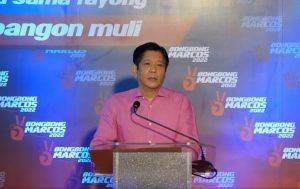
A screenshot of the Facebook video of Ferdinand "Bongbong" Marcos Jr. announcing his presidential candidacy on Oct v, 2021.
Credit: Facebook/Bongbong MarcosThe son of the late Philippine dictator Ferdinand Marcos appear yesterday his candidacy for next year's presidential elections, reopening a long-running argue nearly his father's political legacy.
Quondam Senator Ferdinand "Bongbong" Marcos Jr. said in a video posted on Facebook that he would bring Filipinos together to face COVID-19 pandemic, which has killed tens of thousands and upended the country's economy. "We must face up the claiming every bit ane – as one country, as one people," Marcos Jr. said. "I volition bring that form of unifying leadership back to our country."
In reality, Bongbong brings to the increasingly crowded presidential race the divisive legacy of his father, who ruled the Philippines for 31 years, including nine nether Martial Law. During that time, Marcos oversaw the murder, imprisonment, and torture of thousands of Filipinos, and stole an estimated $10 billion from the national accounts, the remains of which are nevertheless beingness hunted down today, while his wife Imelda became an international byword for decadent extravagance. Marcos was toppled from power by mass public demonstrations in 1986, and died in exile in Hawaii three years afterward.
Loretta Ann Rosales, a former chairwoman of the Commission on Human Rights and a political detainee who was detained and tortured during the Marcos era, told the Associated Press that Bongbong's presidential bid "seeks to institutionalize the nighttime, decadent and tyrannical legacy of his begetter and demolition our efforts to exact full accountability from his family."
"We must non allow him to use his family unit's ill-gotten wealth to fund his presidential appetite, whitewash their crimes against the people and complete their quest for historical distortions," she told the news agency.
That the son of a brutal leader could be in a position to run for president at all is testament to the power of money – in particular, inherited money – in Philippine politics. Far from facing accountability for the corruption and large-scale human rights violations of the Martial Constabulary era, the Marcos family were allowed to return to the Philippines and to political prominence, particularly in their home province of Ilocos Norte.
Imelda has served several terms in the House of Representatives, while the couple's eldest daughter Imee was elected to the Senate in 2019, after a long spell as the governor of Ilocos Norte. Bongbong has also served in the same two positions, and narrowly lost election as vice president in 2016. The provincial assistants of Ilocos Norte is very much the family business. In September 2020, the Philippine House of Representatives approved a bill officially declaring September eleven, the dictator's altogether, a public vacation in Ilocos Norte. Last month, Bongbong's 27-year-old son Ferdinand "Sandro" Alexander announced his candidacy for the congressional post of Ilocos Norte's first district.
Every bit I've noted in these pages before, this rehabilitation is underpinned past the broader fact that the fall of Marcos and the render of competitive elections did little to change the Philippines' skewed distributions of power. Although the new Constitution passed in 1987 explicitly banned "political dynasties," the nation remained in the grip of a network of rich families, who as of 2013 still governed in 72 of the Philippines' 80 provinces. Since the 1980s, the Philippine aristocracy has fiercely resisted any attempts to interruption up the concentrated land holdings that underpin this unequal distribution of wealth, a reality that continues to bend Philippine politics toward oligarchy.
The material failures of the by iii decades have opened up spaces for populists and former Marcos supporters to rehabilitate the Martial Constabulary era. As Gretchen Abuso of the Philippines' Xavier University wrote in these pages last month, "the Marcoses and their well-oiled machinery are experts in the study of collective memories of Filipinos." They have been canny in contrasting the unvarnished present with a rose-tinted vision of the Marcos era as a time of gild and progress.
An of import role has been played by President Duterte, who enjoyed support from former Marcos allies during his political career in Mindanao and has repeatedly expressed his admiration for Marcos. Later coming to office in 2016, he kept a campaign promise to allow Marcos' remains to be buried in the Heroes' Cemetery in Manila. (A survey at the fourth dimension found 59 percent of respondents supported the idea.) In 2017, Duterte issued a presidential proclamation praising Marcos every bit a "World War II veteran, distinguished legislator, and old president."
Public opinion surveys suggest that Bongbong has some chance. In June the local pollster Pulse Asia found he was the preferred candidate of xiii percent of respondents – a low total, but still was the third-about preferred candidate in a divided field, behind Manila mayor Francisco Isko Moreno (14 per centum) and Duterte's girl Sara Duterte-Carpio (28 pct). With Sara non nevertheless committed to running every bit her father's successor, in that location is every likelihood that Marcos could end up the continuity candidate promising a continuation of the Duterte legacy. Saddled with his father'south baggage, can Bongbong Marcos "Make the Philippines Great Again, Over again?"
Source: https://thediplomat.com/2021/10/son-of-the-philippine-dictator-marcos-announces-presidential-campaign/
0 Response to "Lets Make This Nation Great Again Philippines"
Post a Comment