Was Japan and America Beefing Before World War 2
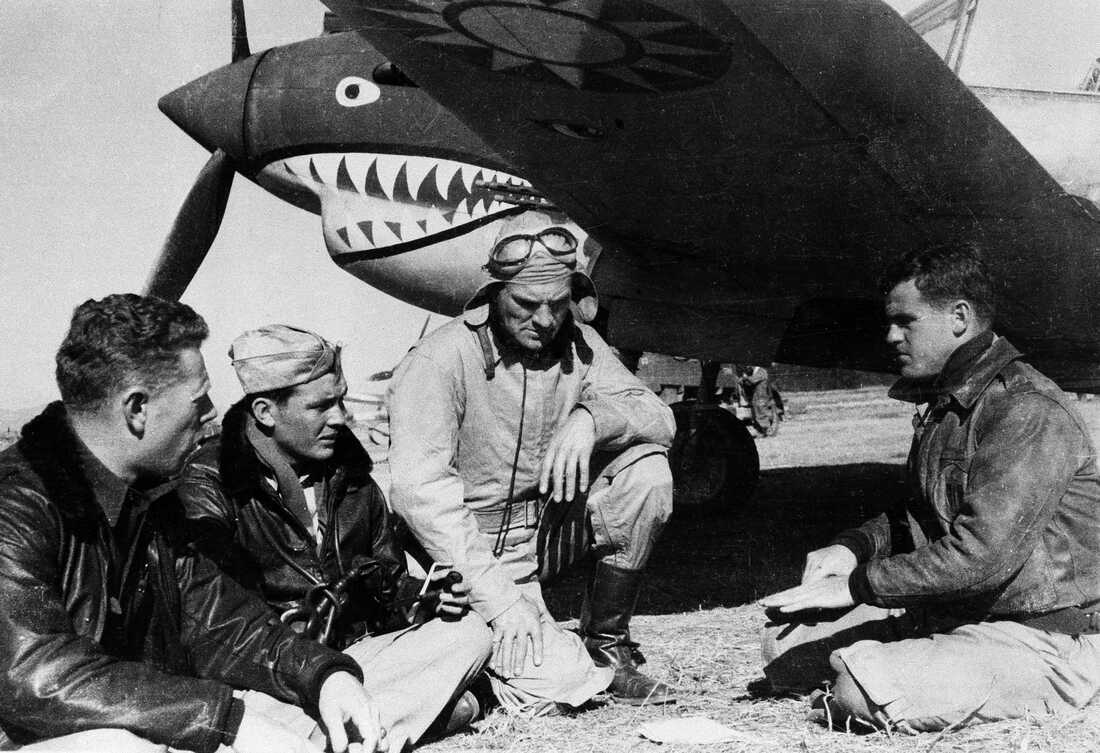
Pilots from the American Volunteer Grouping sit in forepart of a P-xl airplane in Kunming, People's republic of china, on March 27, 1942. The group was notable for its unusual mission: Its members were mercenaries hired past China to fight against Nippon. AP hide caption
toggle caption
AP

Pilots from the American Volunteer Group sit in front of a P-forty airplane in Kunming, People's republic of china, on March 27, 1942. The group was notable for its unusual mission: Its members were mercenaries hired past China to fight against Nihon.
AP
Lxxx years agone this week, a modest group of American aviators fought in their offset battle in World War II.
Their mission was unusual: They were mercenaries hired past China to fight confronting Japan.
They were called the American Volunteer Group and subsequently became known every bit the Flying Tigers. Though only in combat for less than vii months, the group became famous at the fourth dimension for its power to inflict outsize impairment on Nihon's amend-equipped and larger aircraft fleet.
Their victories came when Japan seemed unstoppable. "The AVG was a brilliant spot in history when everything was dour and black, and they have received a lot of recognition for that," says Larry Jobe, president of the Flying Tiger Historical Arrangement.
On the 80th anniversary of their beginning combat, here'due south an abbreviated history of how Americans ended upwards fighting for China.
The Sino-Japanese war

Japanese troops blitz in to attack Chinese soldiers at Changsha in 1939. In 1941, Japan was on the offensive in its war against China. Keystone/Getty Images hide caption
toggle explanation
Keystone/Getty Images
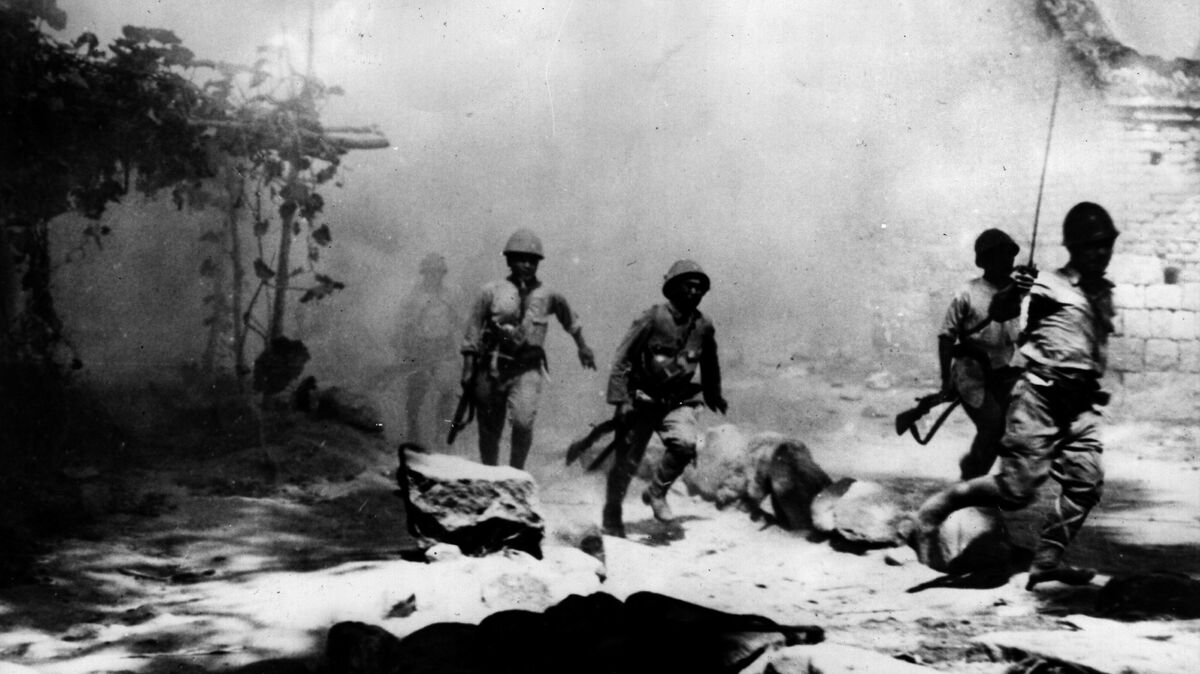
Japanese troops blitz in to attack Chinese soldiers at Changsha in 1939. In 1941, Japan was on the offensive in its war against China.
Keystone/Getty Images
In the W, 1939 is considered the start of World State of war II. But in Asia, China and Japan had been at war since 1937.
China was already fighting its own civil state of war between the Nationalists of Chiang Kai-shek and Communist forces. The 2 sides came to a truce to fight confronting the Japanese. China, however, had little air power to fend off Japanese bombings.
Enter Claire Lee Chennault, a U.South. Army aviator, instructor and tactician, one time described by Time magazine as "lean, hard-bitten, taciturn." Health problems and disputes with his superiors pushed him into retirement from his position with the Army Air Corps in 1937, at historic period 43.
But he quickly got a lucrative task offer with the Chinese Air Strength, which was operating under Chiang's Nationalist regime. Chennault was asked to come survey the readiness of its fleet.
"Chiang Kai-shek thought he had 500 airplanes," says Nell Chennault Calloway, who is Chennault's granddaughter and CEO of the Chennault Aviation & Armed forces Museum in Monroe, La. "Chennault said, 'You take 500, but you only accept 91 that fly.' That's how far backside they were in aviation."
Once the war with Japan officially broke out that summertime, China hired Chennault as an adviser to its air force. He became its de facto commander.

Claire Lee Chennault first went to China to survey the Chinese Air Force'due south readiness, and stayed on to lead the cosmos of the American Volunteer Grouping. Fox Photos/Getty Images hide caption
toggle caption
Trick Photos/Getty Images
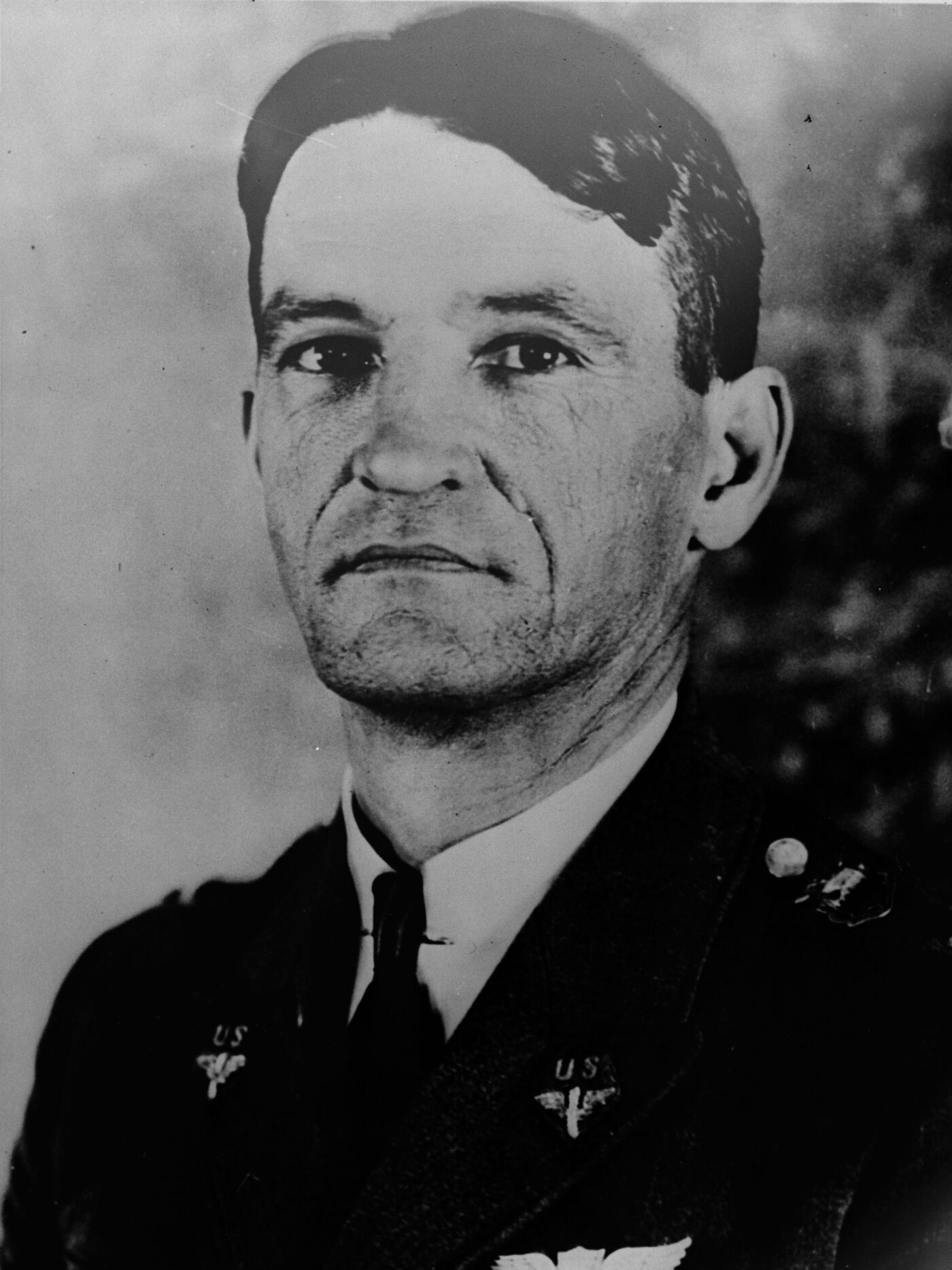
Claire Lee Chennault first went to China to survey the Chinese Air Force's readiness, and stayed on to lead the creation of the American Volunteer Group.
Fox Photos/Getty Images
By 1940, after losing backing from the Soviets, China desperately needed more than planes. At the time, the U.S. was not officially office of Earth State of war II. But President Franklin Delano Roosevelt was concerned nearly the prospect of Nippon defeating China and turning its sights on the U.S.
Chennault traveled dorsum to the U.S., pulling what strings he could to go planes. With the help of T.5. Soong, a Chinese official who was also Chiang'south brother-in-law, a deal was worked out to allow China to buy 100 American-fabricated Curtiss P-40 fighter planes.
As for who would wing and maintain them, many of the pilots in Mainland china'southward existing air force were poorly trained. So Chennault sent recruiters to U.S. military machine bases.
"He managed to get Roosevelt to let some of our military machine pilots — that was the original AVG — to resign their commissions in the U.S. military and get to Cathay as mercenaries, basically, because information technology was confronting the international rules for any American war machine person to be involved in the conflict over there," Jobe tells NPR.
This was mid-1941 — before Pearl Harbor and before the U.S. alleged state of war on Nihon.
"By using Chinese funds to buy the aircraft and supplies and pay the salaries of the proposed crews, the U.S. government could retain a façade of neutrality, while helping China against the Japanese," the Section of Defense force'due south history of the Flying Tigers explained.
To brand recruitment easier, pilots and mechanics were offered pay that was often more than than double what they were making before.
So in summer and fall of 1941, 99 pilots — 59 from the Navy, seven Marines, and 33 from the Army — traveled to Asia, along with about 200 support crew, according to the DOD's history. Almost a dozen of them were Chinese Americans, says Yue-him Tam, a Macalester College history professor who studies China and Japan.
Those who traveled had various motivations — a change of scenery or a chance to show their skills in combat. Calloway thinks many stayed to help with the "desperate situation" in China. Some came for the money.
Pilot Gregory "Pappy" Boyington, who would keep to receive the Medal of Honour and the Navy Cross, told Aviation History Magazine in the 1980s: "I resigned my committee and accepted the job with the AVG in September 1941, since rank was dull in coming and I needed the money. ... And with an ex-wife, three kids, debts and my lifestyle, I really needed the work."
Burma was central to keeping China supplied
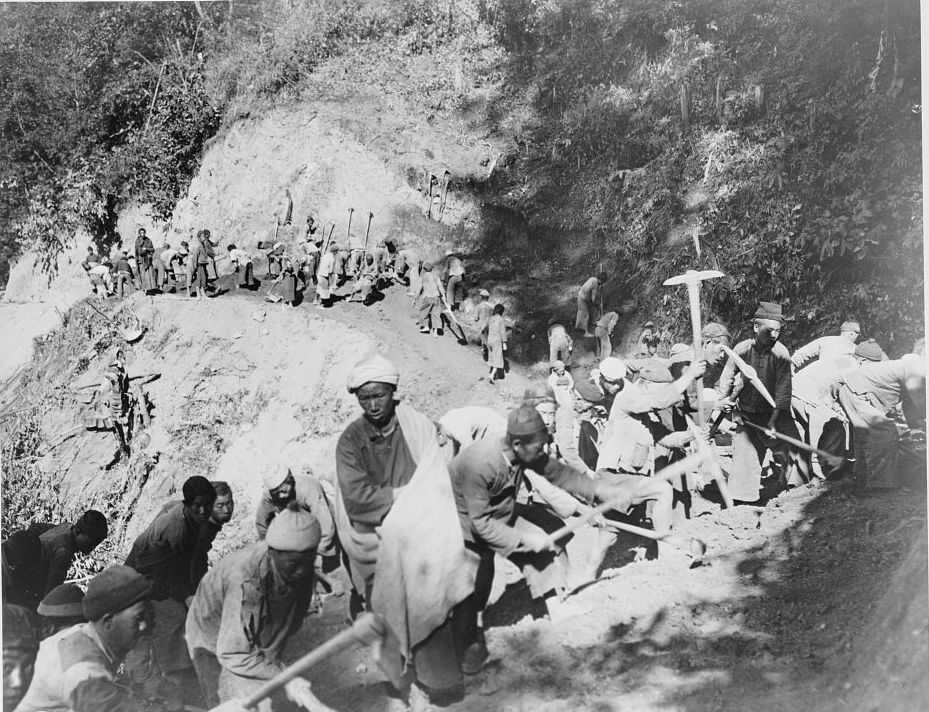
Chinese laborers working to repair the Burma Road in southwest Cathay, circa 1944. During World State of war II, this long windy road from Burma through the mountains was essential to keeping People's republic of china supplied. U.Southward. Ground forces Signal Corps/Library of Congress hibernate caption
toggle caption
U.S. Regular army Bespeak Corps/Library of Congress

Chinese laborers working to repair the Burma Road in southwest China, circa 1944. During Globe War II, this long windy route from Burma through the mountains was essential to keeping Cathay supplied.
U.South. Ground forces Signal Corps/Library of Congress
The AVG's base was in Kunming in southwestern China, far from areas under Japanese occupation.
At that place was a hitch to being there, however — no runways to land planes.
So thousands of Chinese built them by mitt. "The Chinese people — the peasants, the working grade people in particular, also — volunteered to help to build those runways and airports and also provide services to the American pilots," Tam tells NPR. "They didn't have any tools, modern tools. They used their bare hands, actually, to build those runways."
Meanwhile, the Americans did some training at a British airfield in Burma, the country now chosen Myanmar.
Their early preparation was not particularly successful. The pilots had far less feel than Chennault had wanted. Three pilots died and planes and equipment were damaged in various accidents.

Members of the American Volunteer Group flew Curtiss P-40 planes, pictured. By performing certain maneuvers, they were able to exploit some weaknesses in the Japanese aircraft. Three Lions/Getty Images hide explanation
toggle caption
Three Lions/Getty Images

Members of the American Volunteer Group flew Curtiss P-40 planes, pictured. By performing sure maneuvers, they were able to exploit some weaknesses in the Japanese aircraft.
Iii Lions/Getty Images
It wasn't long before they had to put their training to use. The Flying Tigers' first combat came on Dec. 20, 1941 — 13 days after Pearl Harbor and 12 days afterwards the U.Due south. alleged state of war on Japan. Japanese bombers attacked the AVG base at Kunming.
The AVG "shot downwardly nine of ten Japanese bombers. So they were the first Americans actually to have a victory in Earth War II," Calloway says. Their only loss was one AVG airplane that the pilot crash-landed after running out of gas; he was uninjured, according to the DOD's history.
In the following days, the focus of their combat quickly shifted to near Rangoon, Burma. Burma was a British colony at the time and the AVG would assist the British air force in defending Rangoon against Japanese attacks.
Burma was of vital importance to China's state of war efforts. Nippon had sealed off China'southward coast from supply lines, and then China depended on supplies coming in from the port of Rangoon over the mountainous Burma Road to Kunming.
The planes of the AVG, the Curtiss P-40, were not as expert as those of the Japanese. Just past performing sure maneuvers as outlined by Chennault — namely, high-speed diving and climbing — the AVG pilots were able to exploit some weaknesses in the Japanese aircraft.
"Although, the A.5.G. was blooded over China, it was the air battles over Rangoon that stamped the authentication on its fame as the Flying Tigers," Chennault afterward wrote in his memoir Mode of a Fighter, equally quoted by the AVG Flying Tigers' official website.

Pak On Lee of Portland, Ore., George Lum of New York City, and Kee Jeung Pon of New York Urban center were among the Chinese American mechanics who served in the AVG. Here they are pictured in Kunming, China, in November 1942 working on a Curtiss P-twoscore of the 23d Fighter Group, which evolved from the AVG. Department of Defense force, Department of the Air Force/National Athenaeum hide caption
toggle explanation
Department of Defense, Department of the Air Strength/National Athenaeum
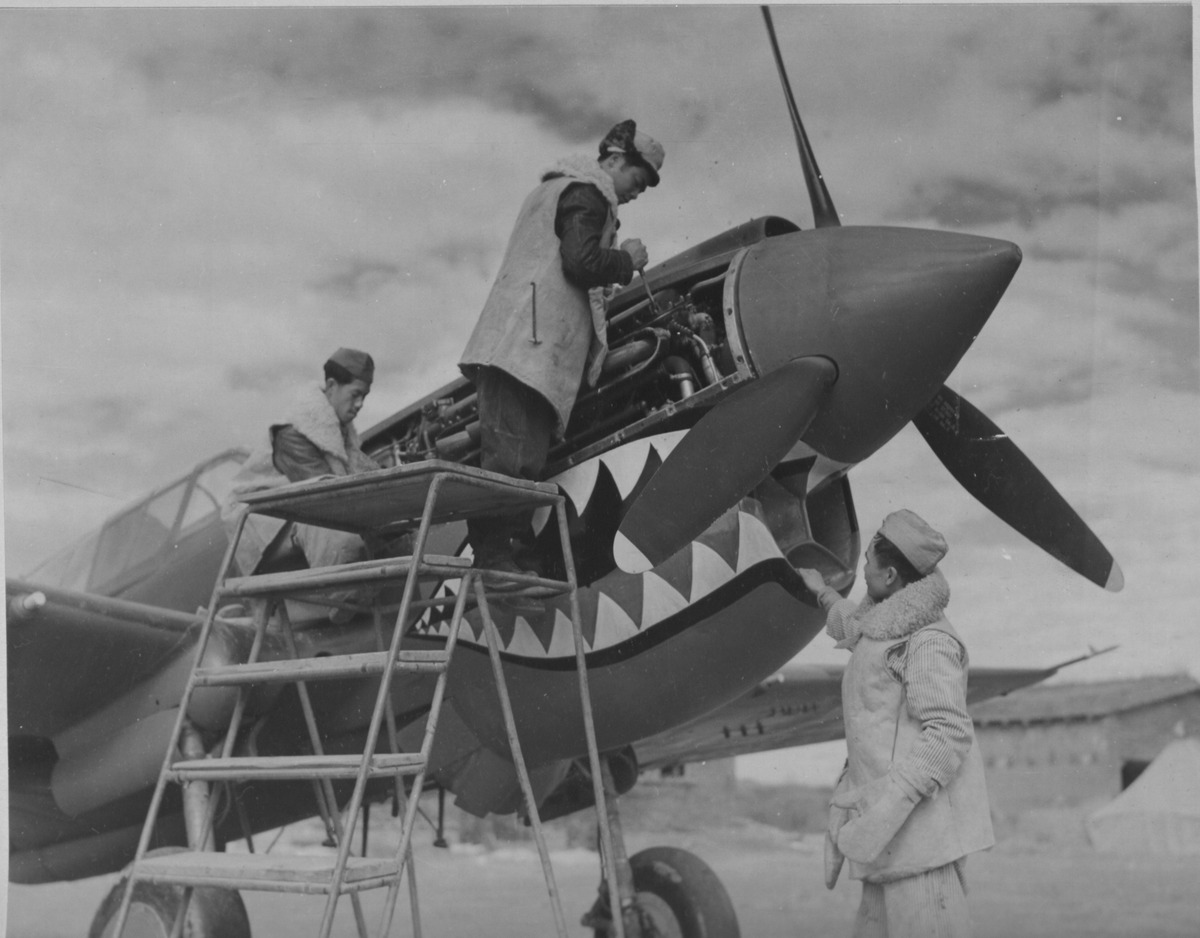
Pak On Lee of Portland, Ore., George Lum of New York City, and Kee Jeung Pon of New York City were among the Chinese American mechanics who served in the AVG. Here they are pictured in Kunming, Mainland china, in November 1942 working on a Curtiss P-xl of the 23d Fighter Grouping, which evolved from the AVG.
Department of Defense, Department of the Air Forcefulness/National Archives
Fighting continued through January and February 1942 in Burma and Japanese-controlled Thailand.
"They are credited with shooting down 299 Japanese airplanes confirmed, nearly that many unconfirmed, and only lost 12 of their ain in actual combat, which is a record that's never been broken to this day," Calloway says.
The Japanese forces, still, outnumbered and overpowered the AVG and the British. Rangoon fell in March 1942. But their efforts slowed down the Japanese advance, kept supply lines open and helped Mainland china keep to fight.
The AVG was integrated into the U.S. military

Pilots of the Flying Tigers run for their Curtiss P-forty fighters as an air raid warning sounds at an unknown airbase in China on Nov. 2, 1943. The AVG was integrated into the U.S. military in 1942 as part of the 23d Fighter Group, which continued to utilize the proper name Flying Tigers. AP hide caption
toggle explanation
AP
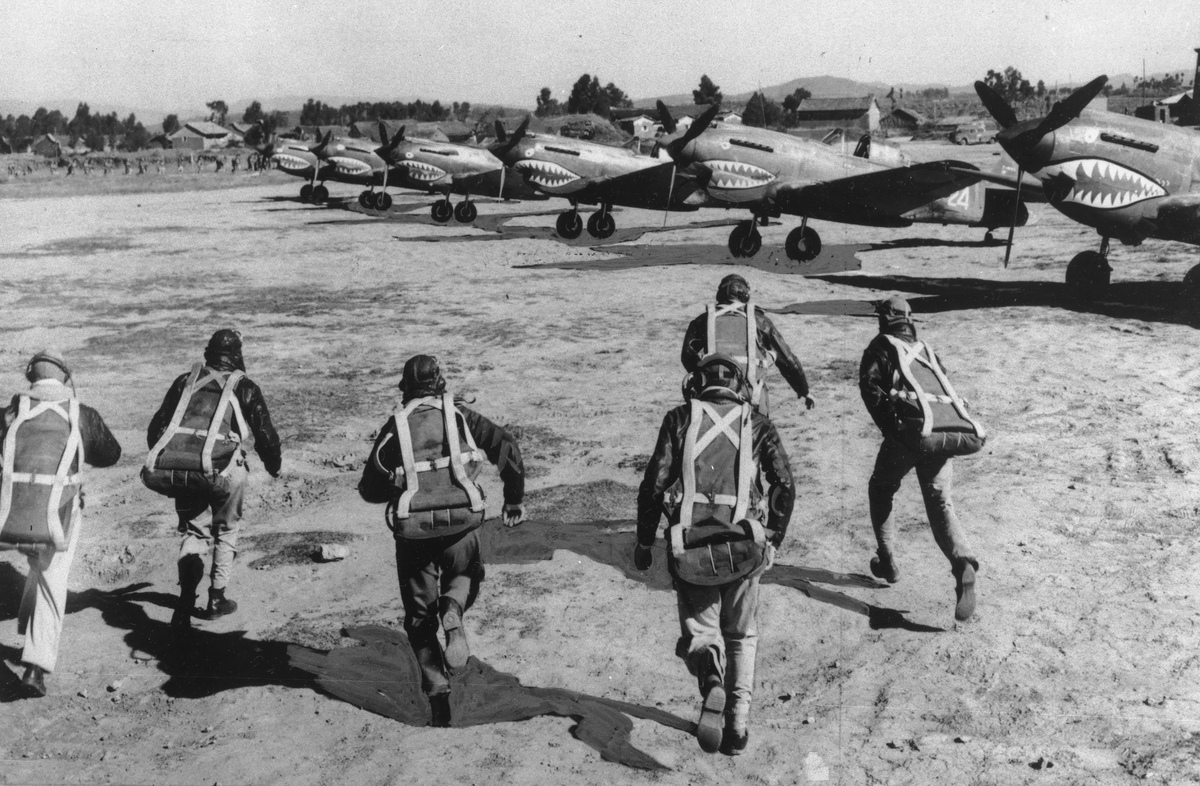
Pilots of the Flying Tigers run for their Curtiss P-40 fighters as an air raid alarm sounds at an unknown airbase in Prc on Nov. 2, 1943. The AVG was integrated into the U.S. military in 1942 as part of the 23d Fighter Group, which connected to use the proper noun Flying Tigers.
AP
By this indicate, the U.S. was formally at war with Japan and there was no need for pretense. U.Southward. military machine leaders pushed for the AVG to exist absorbed into the U.S. Army Air Forces. Chennault rejoined the Army in April 1942.
The AVG connected to fly missions into the spring and summer, including stopping a Japanese advance over a crucial river gorge in May, later on which Japan "never once more threatened" China from the westward, the DOD history notes.
On July 4, 1942, the AVG was officially integrated into the new 23d Fighter Group. A scattering of pilots and support crew stayed on, but near of the men from the original AVG rejoined their previous branch of the military. Others became noncombatant send pilots in China or went back to the U.S. to work as civilians.
Chennault was promoted to brigadier general and led the China Air Task Force, which included the 23d and other units, before assuming command of the 14th Air Force in Communist china in March 1943. He stayed in China for the rest of the war, before retiring from the war machine (again) in 1945.
An 80-yr legacy

A visitor walks past the images and old uniforms of the Flight Tigers at the Anti-Japanese State of war Museum in Dayi county in Red china's Sichuan province in 2005. Museums and memorials in China and the U.S. remember the AVG. Liu Jin/AFP via Getty Images hide caption
toggle explanation
Liu Jin/AFP via Getty Images

A visitor walks past the images and former uniforms of the Flying Tigers at the Anti-Japanese War Museum in Dayi county in China'due south Sichuan province in 2005. Museums and memorials in China and the U.S. call back the AVG.
Liu Jin/AFP via Getty Images
The AVG quickly gained fame in the U.Due south. and China for its early on victories — it was a morale heave when the war was going in Nihon's favor.
Information technology's unclear who came up with the nickname "Flying Tigers," though information technology was used as early on equally a week after their first battle, when Time magazine said the "Flight Tigers swooped, allow the Japanese have information technology." Other publicity came when T.V. Soong, who had earlier worked with Chennault in Washington to gather the planes, helped get The Walt Disney Company design the group'south logo of a Bengal Tiger jumping through a V for victory sign. And John Wayne played a character based on Chennault in the 1942 flick Flying Tigers.
Today in that location are several plaques, memorials and museum exhibits dedicated to the Flying Tigers in China, the U.S., Taiwan and Thailand. The Flight Tiger Heritage Park opened in 2015 in the southern Chinese city of Guilin, built in collaboration with Jobe's Flight Tiger Historical Organization.
The last surviving member of the original AVG, Frank Losonsky, died in February 2020.

A group of 52 U.S. World War II veterans who had served in China, including members of the Flying Tigers, visit Chongqing, Communist china, in 2005 to attend memorial events. China Photos/Getty Images hibernate caption
toggle caption
Red china Photos/Getty Images
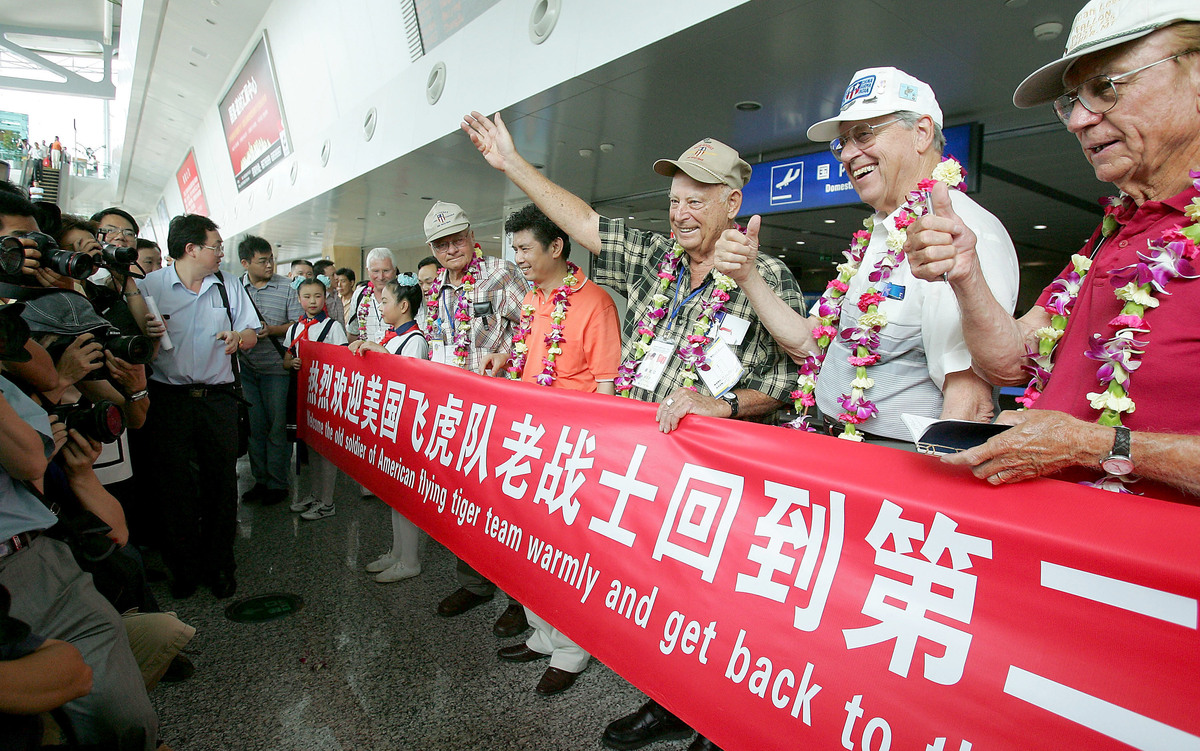
A group of 52 U.S. Globe War 2 veterans who had served in China, including members of the Flying Tigers, visit Chongqing, Communist china, in 2005 to attend memorial events.
Communist china Photos/Getty Images
Flying Tigers historians are quick to point out how essential ordinary Chinese people were to the mission. Those who paved runways did so equally volunteers, Tam says, "to assistance the American fighters because they were fighting for China, fighting for freedom."
Chinese villagers also suffered immensely to help when pilots were shot down. "The Japanese would go into these villages and they would torture and mutilate and kill the villagers in an endeavour to notice out where the Flight Tigers were. And in most instances, the villagers would not tell them," Jobe says. "They would endure the consequences."
"I think, really, the remembrance and the respect for the Flying Tigers was really 18-carat in Communist china," Tam says.
"The people of the United States volunteered to help Red china. They put their lives at take a chance to save the Chinese," he adds, leading many Chinese to call up of those Americans as "always friends of People's republic of china."
Source: https://www.npr.org/2021/12/19/1062091832/flying-tigers-americans-china-world-war-ii-history-japan
0 Response to "Was Japan and America Beefing Before World War 2"
Post a Comment